
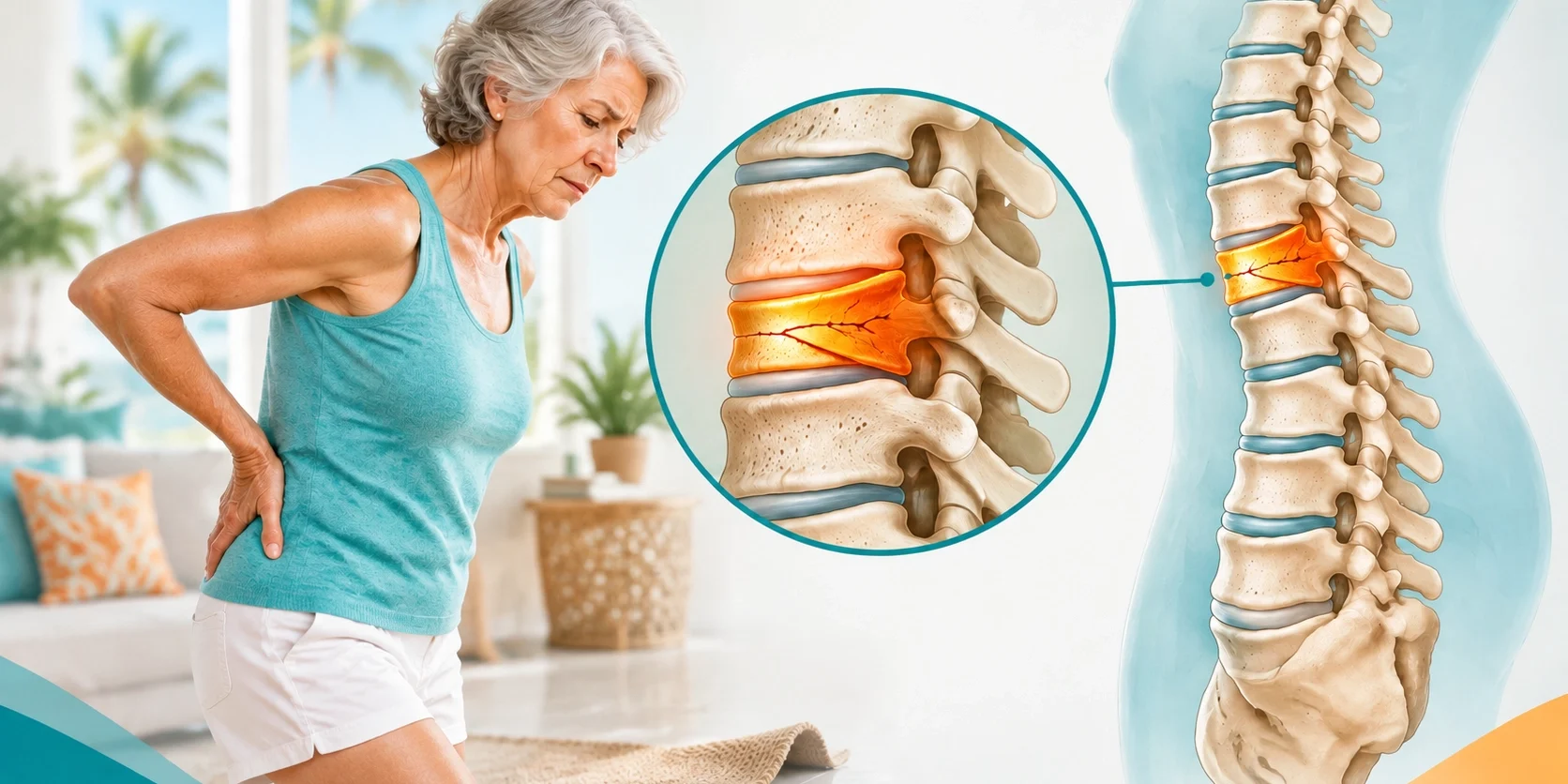
Yes: a simple fall can cause a spinal compression fracture, especially if osteoporosis has weakened your vertebrae. New or sudden back pain after a ground-level fall, gradual height loss, or a newly stooped posture should be evaluated by a medical professional, even if the fall seemed minor.
For older adults in Venice, Port Charlotte, Sarasota, and throughout Southwest Florida, recognizing the signs early may help prevent worsening pain, reduced mobility, and additional fractures. At Family Spine & Pain Care Institute, our board-certified pain physicians evaluate spinal pain and may recommend non-surgical care or minimally invasive treatments such as kyphoplasty and vertebroplasty when appropriate.
Why Can a Simple Fall Break the Spine?
Your spine is made up of stacked bones called vertebrae. A vertebral compression fracture occurs when one of these bones cracks and collapses, often becoming shorter in the front and developing a wedge-like shape.
In a healthy spine, a minor fall may cause bruising or muscle strain. However, osteoporosis can make the vertebrae fragile enough to fracture from relatively low-impact events, including:
- A fall from standing height
- Slipping in the bathroom
- Reaching, twisting, or bending
- Lifting a light object
- Coughing or sneezing
- Stepping off a curb or uneven surface
According to the American Academy of Orthopaedic Surgeons, spinal fractures are among the most common fractures associated with osteoporosis. In some cases, the fracture happens without a clear accident and is discovered during an X-ray or other imaging study.
How Does Osteoporosis Increase Your Risk?
Osteoporosis is a condition that causes bones to become thinner, weaker, and more likely to break. It often develops gradually, and many people do not know they have it until they experience a fracture.
The risk of osteoporosis increases with age, particularly after menopause. Other risk factors may include:
- A previous fracture after a minor injury
- Family history of osteoporosis
- Low body weight
- Long-term steroid medication use
- Smoking
- Excessive alcohol use
- Limited physical activity
- Certain thyroid, kidney, or digestive conditions
A spinal compression fracture may be the first visible sign that your bones need further evaluation. Your physician may recommend a bone-density test, such as a DEXA scan, and discuss strategies to reduce the risk of future fractures.
What Are the Common Symptoms of a Spinal Compression Fracture?
Some spinal compression fractures cause few or no symptoms. Others cause sudden, severe pain that makes standing, walking, or changing positions difficult.
Common symptoms include:
- Sudden mid-back or low-back pain
- Sharp, aching, or “knife-like” pain
- Pain that worsens when standing or walking
- Increased pain when bending, twisting, coughing, or sneezing
- Tenderness over a specific area of the spine
- Difficulty standing upright
- Reduced mobility or difficulty completing daily activities
- Muscle fatigue and spasms around the spine
Pain may improve when you lie down, but that does not mean the injury should be ignored. A fracture can continue to affect your posture and mobility even after the most intense pain begins to fade.

Can a Spinal Compression Fracture Cause Height Loss?
Yes. Height loss is a common long-term sign of one or more spinal compression fractures.
When a vertebra collapses, the spine becomes shorter. Multiple fractures can lead to:
- Losing noticeable height over time
- A rounded or hunched back
- Forward-leaning posture, known as kyphosis
- Difficulty looking straight ahead while walking
- Increased pressure on spinal muscles
- Reduced balance and confidence with movement
A gradual change in height may be easy to dismiss as normal aging. However, losing more than an inch of height or noticing a new stooped posture should prompt a conversation with your healthcare provider.
The National Library of Medicine’s MedlinePlus guidance on back compression fractures explains that some patients may experience significant height loss over time when multiple vertebrae are affected.
When Should You Seek Urgent Medical Care?
Most spinal compression fractures do not damage the spinal cord. Still, serious symptoms require prompt evaluation.
Seek urgent medical attention if your back pain is accompanied by:
- New numbness or tingling
- Weakness in one or both legs
- Difficulty walking or standing
- Loss of bowel or bladder control
- Severe pain that does not improve with rest
- Pain after a significant fall or accident
These symptoms may indicate pressure on the spinal cord or nerves. If you have sudden weakness, loss of bladder or bowel control, or an inability to walk, seek emergency care immediately.
How Is a Spinal Compression Fracture Diagnosed?
Your physician will begin by asking how your pain started, whether you experienced a fall, and how the pain affects your daily activities. A physical examination may assess spinal tenderness, posture, movement, strength, reflexes, and sensation.
Imaging may include:
- X-rays: Identify vertebral height loss or a wedge-shaped fracture
- CT scans: Show more detail about the bone and spinal canal
- MRI scans: Help determine whether a fracture is new and whether swelling or nerve involvement is present
- Bone-density testing: Evaluates for osteoporosis and future fracture risk

Identifying whether the fracture is recent is important when considering minimally invasive treatments. Your symptoms and imaging findings should match before a procedure is recommended.
What Are the First Treatments for a Compression Fracture?
Most patients begin with non-surgical treatment. The exact plan depends on the severity of the fracture, your overall health, pain level, and ability to function.
Conservative care may include:
- Medication for pain and inflammation, when medically appropriate
- Short-term activity modification
- A brace for selected patients
- Gradual return to movement rather than prolonged bed rest
- Physical therapy to improve posture, strength, and balance
- Osteoporosis evaluation and treatment
- Fall-prevention strategies at home
Many compression fractures become less painful over several weeks. However, persistent severe pain can interfere with sleep, walking, personal care, and activities you enjoy, such as golfing, visiting family, or attending social events.
Could Kyphoplasty Help Relieve Fracture Pain?
Kyphoplasty is a minimally invasive vertebral augmentation procedure. It may be considered when you have a recent, painful compression fracture that has not improved adequately with non-surgical care.
During kyphoplasty:
- A physician guides a small needle into the fractured vertebra.
- Fluoroscopic, or live X-ray, guidance helps position the instruments accurately.
- A small balloon is inserted and gently inflated inside the vertebra.
- The balloon may help restore some vertebral height and create a cavity.
- The balloon is removed, and medical-grade bone cement is placed in the space to stabilize the bone.

Kyphoplasty is not appropriate for every patient or every fracture. Your physician will consider the fracture’s age, location, severity, imaging findings, osteoporosis status, and other health conditions.
At Family Spine & Pain Care Institute, kyphoplasty is performed as a targeted, minimally invasive procedure rather than open spine surgery. Many procedures are completed on an outpatient basis, but your physician will explain the expected recovery and activity restrictions for your individual situation.
How Is Vertebroplasty Different From Kyphoplasty?
Vertebroplasty is another minimally invasive treatment for selected painful spinal compression fractures. Instead of using a balloon, the physician places bone cement directly into the fractured vertebra to help stabilize it.
| Treatment | How it works | Main goal |
|---|---|---|
| Kyphoplasty | Balloon inflation followed by cement placement | Stabilize the fracture, relieve pain, and potentially restore some height |
| Vertebroplasty | Direct injection of bone cement | Stabilize the vertebra and reduce fracture-related pain |
Both procedures require careful patient selection. They are generally considered when pain is severe, clearly linked to a recent fracture, and continues to limit function despite appropriate non-surgical treatment.
Potential risks can include cement leakage, infection, bleeding, nerve irritation, or additional fractures. Your physician will review the benefits and risks before recommending treatment.
How Can You Protect Your Spine After a Fracture?
Treating the current fracture is only part of protecting your long-term health. If osteoporosis contributed to the fracture, addressing bone weakness is essential.
Ask your healthcare provider about:
- Bone-density testing
- Osteoporosis medications
- Calcium and vitamin D recommendations
- Safe weight-bearing and strengthening exercises
- Physical therapy
- Vision and balance evaluations
- Removing trip hazards from your home
- Installing handrails and bathroom safety equipment
Preventing another fall and improving bone strength may help you maintain mobility and independence.
Spinal Compression Fracture Care in Venice, Port Charlotte, and Sarasota
Family Spine & Pain Care Institute provides personalized pain care for adults throughout Venice, Port Charlotte, Sarasota, and Southwest Florida. Our board-certified physicians use a compassionate, evidence-informed approach to understand the source of your pain and discuss options that may help you return to daily activities.
Our practice emphasizes:
- Non-surgical treatment whenever appropriate
- Minimally invasive outpatient procedures
- Fluoroscopic, live X-ray guidance
- Personalized care plans
- A focus on mobility and quality of life
- Medicare, Medicaid, major commercial insurance, and Workers’ Compensation cases
Venice clinical office:
1505 S. Tamiami Trail, Suite 405
Venice, FL 34285
Venice procedure location:
1525 S. Tamiami Trail, Suite 601
Venice, FL 34285
Port Charlotte office:
3390 Tamiami Trail, Suites 201 & 202
Port Charlotte, FL 33952
Office hours: Monday–Friday, 8:00 a.m.–5:00 p.m.
Phone: (941) 237-0050
A Sarasota location is coming soon. Call our office for the latest information about availability and scheduling.
👉 Schedule an appointment with Family Spine & Pain Care Institute or call (941) 237-0050 to discuss new or persistent back pain after a fall.
Q&A: Spinal Compression Fractures
Can a small fall really fracture my spine?
Yes. A minor fall can fracture a weakened vertebra, particularly if you have osteoporosis or low bone density. New back pain after a fall should be evaluated rather than assumed to be a muscle strain.
How do I know if my back pain is from a compression fracture?
Compression-fracture pain is often sudden, localized, and worse when standing, walking, bending, or changing positions. Imaging is needed to confirm the diagnosis.
Will a compression fracture heal without surgery?
Many spinal compression fractures improve with non-surgical care, including medication, activity modification, bracing when appropriate, and physical therapy. If severe pain persists and limits your function, kyphoplasty or vertebroplasty may be considered.
Is kyphoplasty the same as vertebroplasty?
No. Both procedures use bone cement to stabilize a fractured vertebra. Kyphoplasty uses a balloon before cement placement and may restore some lost vertebral height; vertebroplasty injects cement directly into the bone.
Does Family Spine & Pain Care Institute treat patients from Sarasota?
Yes. Patients from Sarasota and surrounding communities may visit our current offices in Venice or Port Charlotte. A Sarasota location is coming soon. Call (941) 237-0050 for scheduling information.
👉 Do not ignore sudden back pain, height loss, or a new stooped posture after a fall. Contact Family Spine & Pain Care Institute at (941) 237-0050 to request an evaluation in Venice or Port Charlotte, Florida.
📍 Contact our team or schedule your appointment today and take the next step toward improved mobility and lasting relief.