
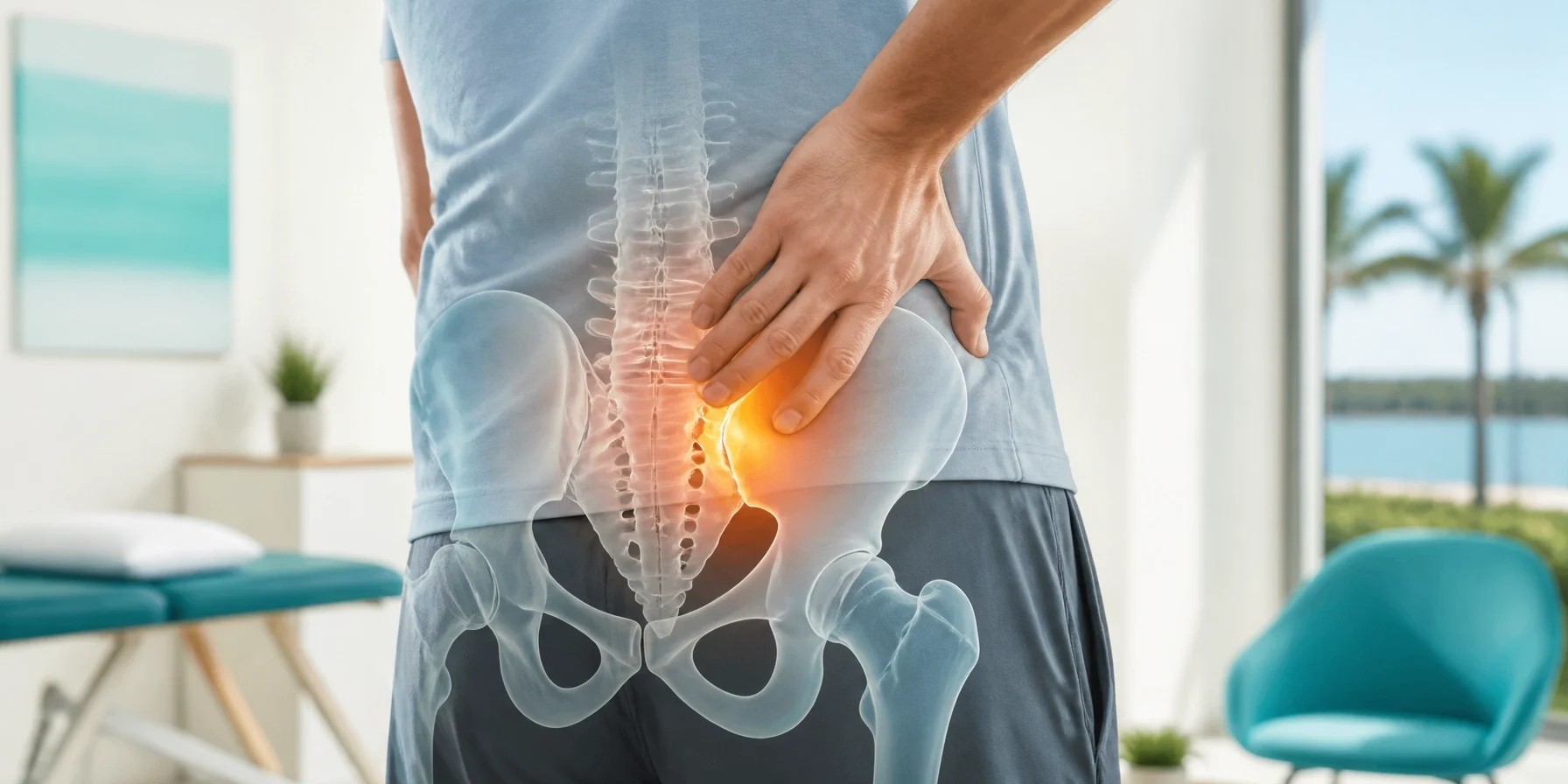
Deep, one-sided pain in your lower back, buttock, or hip may be coming from your sacroiliac joint: not just your lumbar spine. The good news is that SI joint pain can often be managed with non-surgical, minimally invasive treatments, including physical therapy, image-guided injections, and radiofrequency ablation.
At Family Spine & Pain Care Institute, our board-certified pain physicians evaluate the source of your pain and create a personalized plan designed to improve mobility, sleep, and your quality of life. We serve patients in Venice, Port Charlotte, Sarasota, and communities throughout Southwest Florida.
Medical note: This article is for educational purposes and does not replace an in-person evaluation. Your treatment plan depends on your symptoms, medical history, examination, and diagnostic findings.
What does SI joint pain feel like?
Your sacroiliac joints connect the sacrum: the triangular bone at the base of your spine: to the left and right sides of your pelvis. These joints help transfer weight between your upper body and legs when you walk, stand, sit, bend, or climb stairs.
SI joint pain may feel like:
- Deep, aching, or sharp pain on one side of your lower back
- Pain in the buttock, outer hip, groin, or upper thigh
- Discomfort that worsens when climbing stairs or walking uphill
- Increased pain after prolonged sitting or standing
- Pain when turning in bed or moving from sitting to standing
- Pelvic stiffness or a feeling that your leg may buckle
- Symptoms that resemble hip pain or sciatica
Because the symptoms overlap with lumbar disc problems, hip arthritis, and muscle-related conditions, an accurate diagnosis is essential. The American Academy of Family Physicians explains that the SI joint may account for approximately one-quarter of chronic low back pain cases.
How is SI joint pain diagnosed?
Diagnosing SI joint pain requires more than looking at a scan. Your physician will review your pain pattern, examine your spine and hips, assess your gait, and evaluate how your pelvis moves.
Your evaluation may include:
- Pain-location assessment: You may be asked to point with one finger to the area that hurts, often near the back of the pelvis.
- Provocation tests: Your physician may perform several controlled movements, such as the thigh-thrust, compression, distraction, Gaenslen, or sacral-thrust tests.
- Neurologic screening: Strength, sensation, reflexes, and leg-raising tests help evaluate whether a pinched nerve may be involved.
- Imaging: X-rays, CT scans, or MRI may help rule out fractures, inflammatory arthritis, tumors, infection, or other spinal and hip conditions.
- Diagnostic injection: A precisely placed anesthetic injection can help determine whether the SI joint is the primary source of your pain.
If you have fever, unexplained weight loss, a recent major injury, progressive leg weakness, new bowel or bladder problems, or severe night pain, seek prompt medical attention.
What are the 7 proven treatment options for SI joint pain?
Treatment typically begins with conservative care. If symptoms continue to limit your walking, work, sleep, or daily activities, your physician may recommend a targeted interventional treatment.
1. Activity modification and medication guidance
Short-term changes to painful activities can reduce stress on the SI joint while you begin treatment. This does not mean you must stop moving completely. In most cases, gradual, comfortable movement is better than prolonged bed rest.
Your care plan may include:
- Temporarily reducing heavy lifting, repetitive bending, or high-impact exercise
- Avoiding positions that worsen your pain, such as prolonged sitting on one side
- Alternating sitting and standing during work or travel
- Using cold or heat when appropriate
- Discussing over-the-counter medications with your physician
Nonsteroidal anti-inflammatory drugs may not be appropriate for everyone, especially if you have kidney disease, stomach ulcers, blood-thinning medication use, or certain cardiovascular conditions. Ask your healthcare provider before starting or continuing them.
2. Physical therapy for pelvic stability
Physical therapy is one of the most important first-line options for SI joint pain. A customized program can improve the way your pelvis, hips, and lower back share the workload.
Your physical therapist may focus on:
- Core and pelvic-girdle stabilization
- Gluteal and hip-abductor strengthening
- Gentle stretching for tight hip flexors, hamstrings, and piriformis muscles
- Posture and movement retraining
- Safer techniques for lifting, walking, and getting out of a chair
- A home exercise plan that supports long-term progress
The goal is not simply to stretch the painful area. It is to improve strength, coordination, and load transfer so your SI joint experiences less strain during everyday movement.

3. Manual therapy and targeted movement training
Some patients benefit from hands-on treatment provided by a qualified physical therapist or clinician trained in manual therapy. This may include soft-tissue techniques, joint mobilization, and movement correction.
Manual therapy may help:
- Reduce muscle guarding around the pelvis
- Improve hip and lower-back mobility
- Address movement patterns that place extra stress on the SI joint
- Make it easier to participate in strengthening exercises
For more lasting relief, manual therapy is generally most effective when combined with an active exercise program rather than used alone.
4. Pelvic or SI support belt
An SI belt is a supportive device worn around the pelvis. It may help some patients: particularly those with pelvic instability or ligament laxity: by limiting painful movement and improving support during walking or standing.
A belt may be useful for:
- Short periods of walking or standing
- Recovery after certain injuries
- Pregnancy-related pelvic discomfort
- Activities that cause the pelvis to feel unstable
A belt should fit correctly and should not replace strengthening or medical evaluation. Your physician or physical therapist can help determine whether it is appropriate for you.
5. Image-guided SI joint injection
An image-guided SI joint injection can serve two purposes: confirming the pain source and reducing inflammation. At Family Spine & Pain Care Institute, procedures are performed with fluoroscopic, or live X-ray, guidance to support accurate needle placement.
During the procedure:
- You are positioned comfortably in an outpatient procedure setting.
- The skin is cleaned and numbed.
- Fluoroscopy helps your physician identify the joint.
- Contrast may be used to confirm the injection location.
- A local anesthetic and medication, such as a corticosteroid, may be delivered as clinically appropriate.
The goal is to place treatment directly where it is needed instead of relying only on medication that travels throughout the body. Relief varies from patient to patient, but reducing pain may make it easier to participate in physical therapy and return to daily activities.
Learn more about sacroiliac joint injections for back pain relief.
6. Radiofrequency ablation for confirmed joint-related pain
If your pain returns after temporary relief from an injection: or continues despite conservative treatment: radiofrequency ablation may be considered.
Radiofrequency ablation uses controlled energy to interrupt pain signals carried by small nerves near the SI joint. It does not remove the joint or require open surgery. Your physician may recommend diagnostic blocks first to confirm that the targeted nerves are contributing to your symptoms.
Potential advantages include:
- A minimally invasive outpatient procedure
- No large incision
- Treatment directed at pain-signaling nerves
- The possibility of longer-lasting relief for appropriately selected patients
- A recovery plan that can include gradual return to normal activity
Results vary, and nerves can eventually recover. RFA is not appropriate for every cause of pelvic or lower-back pain.

7. Minimally invasive SI joint fusion
Although SI joint fusion is not technically a non-surgical treatment, it is a minimally invasive option that may be discussed when severe, confirmed SI joint pain continues despite appropriate conservative and interventional care.
Fusion stabilizes the painful joint using implants placed through small incisions. It is generally reserved for carefully selected patients with:
- Persistent, function-limiting symptoms
- A clear diagnosis supported by examination and diagnostic testing
- Failure of physical therapy, medication management, injections, and possibly RFA
- Structural instability or degeneration that supports a stabilization procedure
Your physician can help determine whether a surgical consultation is appropriate. Many patients will never need fusion, and less invasive options are typically considered first.
What can you expect from treatment in Southwest Florida?
Family Spine & Pain Care Institute focuses on personalized, non-surgical, and minimally invasive pain care. Our board-certified physicians use fluoroscopic guidance when appropriate and perform many procedures on an outpatient basis.
Many patients can return to light activities within 24 to 48 hours, depending on the procedure and their individual recovery instructions. Your physician will explain restrictions, medication guidance, warning signs, and when to resume exercise, driving, work, golf, or social activities.
We accept Medicare, Medicaid, most major commercial insurance plans, and Workers’ Compensation cases. Coverage and authorization requirements vary, so our team can help verify your benefits.
Where can you receive SI joint care in Venice, Port Charlotte, and Sarasota?
Our current Southwest Florida offices include:
- Venice clinical office: 1505 S. Tamiami Trail, Suite 405, Venice, FL 34285
- Venice procedure location: 1525 S. Tamiami Trail, Suite 601, Venice, FL 34285
- Port Charlotte office: 3390 Tamiami Trail, Suites 201 & 202, Port Charlotte, FL 33952
Office hours are Monday through Friday, 8:00 a.m. to 5:00 p.m. Call (941) 237-0050 to schedule care at our Venice or Port Charlotte locations.
SI Joint Pain Q&A
Can SI joint pain cause hip or leg pain?
Yes. Pain from the SI joint may spread into the buttock, outer hip, groin, or upper thigh. It can sometimes resemble hip arthritis or sciatica, which is why a clinical evaluation is important.
Is an SI joint injection painful?
The skin is numbed before the injection, and fluoroscopic guidance helps your physician place the needle accurately. You may feel pressure or brief discomfort, but your care team will monitor you throughout the outpatient procedure.
How long does recovery take after an SI joint procedure?
Recovery depends on the procedure and your health. Many minimally invasive outpatient procedures allow a return to light activity within 24 to 48 hours, but you should follow your physician’s specific instructions.
Will I need surgery for SI joint pain?
Usually, treatment starts with physical therapy, activity modification, medication guidance, and other non-surgical options. Minimally invasive fusion is generally considered only when symptoms remain severe and the SI joint has been confirmed as the pain source.
Take the next step toward lasting relief
You do not have to continue adjusting your life around lower-back, buttock, or hip pain. A careful diagnosis can identify whether your SI joint is contributing to your symptoms and help you choose a treatment path focused on mobility and quality of life.
👉 Call Family Spine & Pain Care Institute at 941-237-0050 to schedule an evaluation.
👉 You can also schedule an appointment online with our compassionate pain specialists serving Venice, Port Charlotte and the surrounding areas.